
Importing
Occupation
How does produce from illegal Israeli settlements enter European markets disguised as Israeli?
Narrated by Brian Eno, this animated explainer brings to life the findings of Global Echo’s four-year investigation and reveals how European complicity in settlement trade fuels Palestinian dispossession—one piece of fruit at a time.
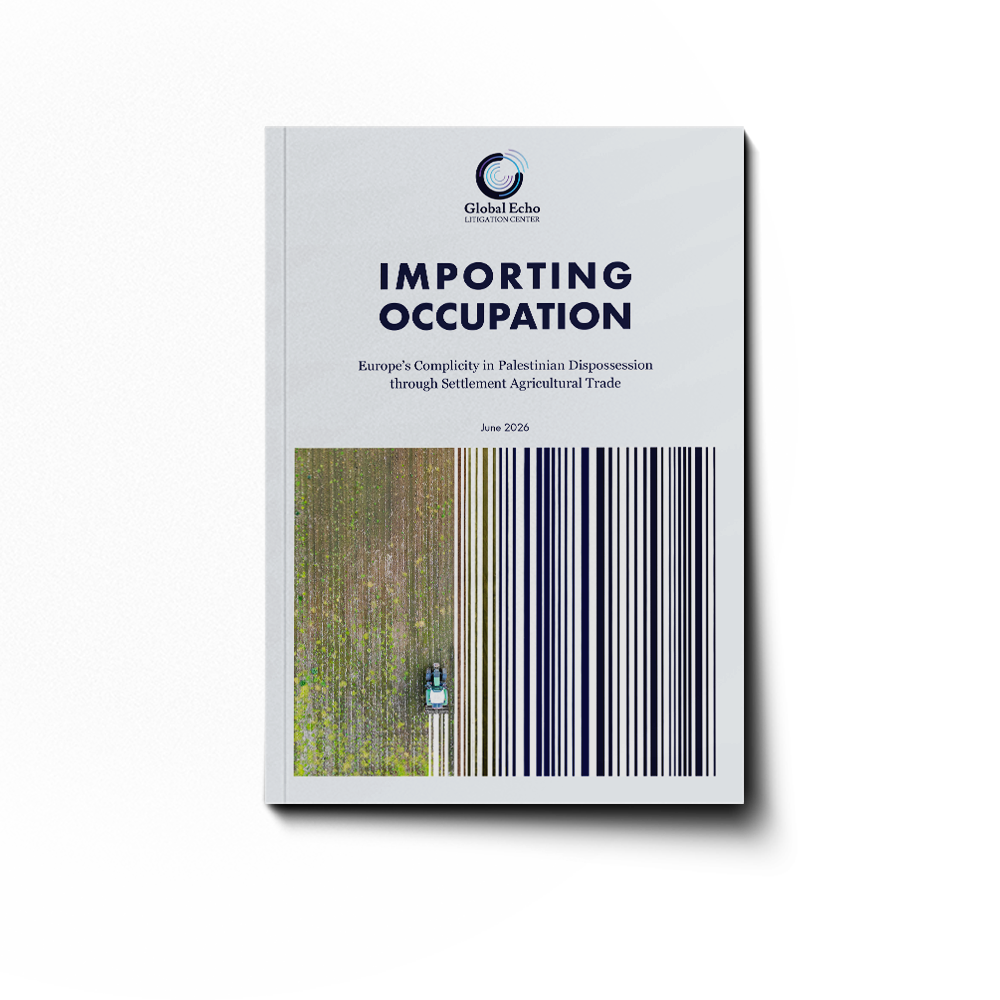
Importing Occupation is based on a body of evidence amassed by Global Echo, of a kind not seen before, that analyzes close to 6,000 Israeli agricultural exports to Europe from the past eight years. It details a complex and widespread system by which agricultural goods produced in illegal Israeli settlements are regularly imported to Europe as if they were Israeli: declaring eligibility for preferential tax treatment on ineligible settlement goods, holding invalid organic and plant health certifications, and bearing the label, “Product of Israel” — violating European law, policy, and trade agreements.
Global Echo’s investigation demonstrates that these failures are not isolated incidents. They form a pattern that violates European laws, trade agreements, and policies. In practice, the entire system blurs the Green Line and conceals the origins of goods produced through displacement, land theft, and exploitation, while European customs agencies, importers, and supermarkets are doing little to stop it.
Global Echo is initiating legal action to force action on these violations, fix the system that allows settlement goods to enter European markets in breach of European and international law, and advance accountability for the broader system of Palestinian dispossession sustained by settlement agriculture.
Read Executive Summary in:
KEY FINDINGS
1
Out of more than 5,900 Israeli shipments containing citrus, dates, tahini, and other produce exported to Europe over the past 8 years (2017 – 2026), 1 in 6 shipments (17.2%) were sourced from settlements. Among shipments to the EU specifically, the proportion rose to 1 in 5 (19.2%). Because of widespread obfuscation of origin, the true scale among agricultural exports is likely higher.
2
Analysis of over 2,000 invoices for shipments of agricultural products to the EU revealed that 16.7% claimed Israeli origin for settlement goods for the purpose of preferential tariff treatment based on the EU-Israel Association Agreement—amounting to €13.1 million euros worth of settlement agricultural products.
3
Even when preferential tariff treatment is rightly denied to settlement products, the Israeli government reimburses exporters, rendering tariffs on settlement products practically meaningless. From 2005 to 2024, at least €63 million euros were paid by the Israeli government to exporters of settlement goods.
4
Organic and plant health certifications for settlement goods are issued unlawfully under EU law and routinely accepted by EU customs authorities, undermining the integrity of, and public confidence in, EU regulatory regimes and posing a risk to public health.
5
Because settlement products are allowed into the EU disguised as Israeli, consumers are frequently misled about the origins of settlement products.
Litigation Updates
This system-wide failure undermines the integrity of, and public confidence in, European legal and regulatory regimes and contributes directly to the economic sustainability and expansion of the Israeli settlement enterprise — the single most enduring and systematic violation of Palestinian human rights.
Global Echo is initiating legal action to force action on these violations and fix the system that allows settlement goods to enter European markets in breach of European and international law.
Global Echo to HMRC: Investigate Tariff Exemptions Improperly Granted to Settlement Products
Global Echo Litigation Center has entered into pre-litigation correspondence with His Majesty’s Revenue & Customs (HMRC) concerning the import of products originating in illegal Israeli settlements that may have improperly received preferential tariff treatment under the UK-Israel Trade and Partnership Agreement. Global Echo has instructed Leigh Day solicitors to act on its behalf.
Drawing on evidence from Global Echo’s recent investigative report Importing Occupation, which was recently featured in The Guardian, the letter raises concerns that agricultural products produced in Israeli settlements in the Occupied Palestinian Territory and occupied Syrian Golan are entering UK ports with declarations of Israeli origin and may be improperly receiving exemption from tariffs, despite UK policy that settlement goods are not entitled to preferential treatment.
In its letter, Global Echo seeks information regarding HMRC’s procedures for verifying product origin and enforcing the exclusion of settlement products from preferential tariff treatment. In particular, Global Echo identifies a number of Israeli exporting companies that its evidence reveals have exported settlement goods to the UK and asks HMRC to explain whether it has taken any steps to check, investigate, or verify preferential tariff claims made in respect of those products, and, if so, what those inquiries found.
Should HMRC fail to adequately address these concerns, Global Echo plans to pursue legal action.
DONATE TODAY
SUPPORT OUR WORK